Innisfail Domestic Violence Support Service

Home / Innisfail Domestic Violence Support Service

What is Domestic and Family Violence?

Domestic and Family Violence (DFV) is the use of violence or abuse in a relationship to maintain power and control over the other person. Behaviours can include:
  • Physical and verbal abuse
  • Non-consensual sexual acts and reproductive control
  • Emotional or psychological abuse
  • Threatening behaviour, including damage to property and threats to hurt a child, relative, or pet
  • Financial abuse
  • Stalking, monitoring, harassment, gaslighting, and isolation
  • Cultural, religious, and spiritual abuse
  • Denying bodily autonomy

What is Coercive Control?

Coercive control involves perpetrators using patterns of abusive behaviours over time in a way that creates fear and denies liberty and autonomy. Major signs include:
  • Isolating you from your support system
  • Monitoring your activity throughout the day
  • Denying you freedom and autonomy
  • Gaslighting
  • Name-calling and putting you down, attacking your self-esteem
  • Limiting your access to money
  • Reinforcing traditional gender roles
  • Turning your children against you
  • Making jealous accusations
  • Regulating your sexual relationship
  • Threatening children or pets

The Cycle of Violence

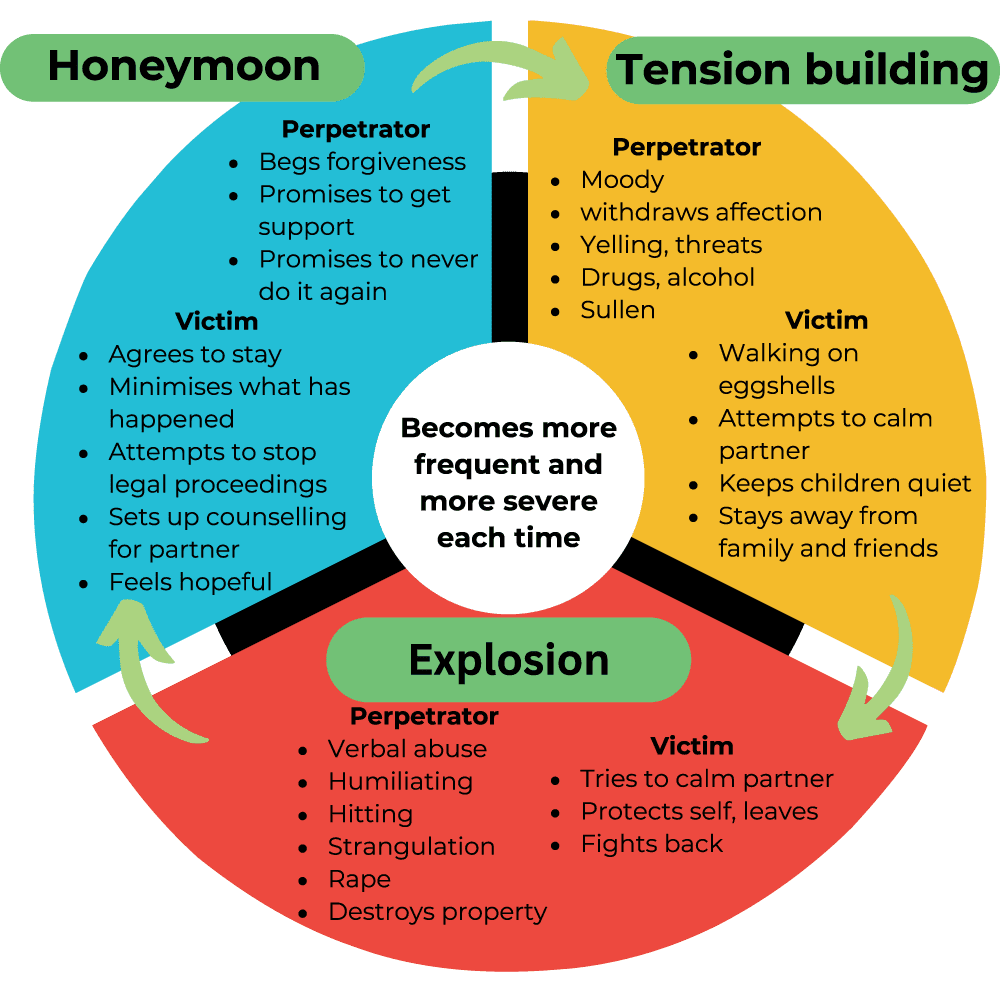
Cycle of Violence diagram — showing phases of abuse in domestic relationships

What is the Cycle of Violence?

The cycle of violence describes a pattern of abuse in a relationship, typically characterised by repeated phases:

  • Tension Building (the “ticking time bomb”)
  • Domestic and Family Violence (DFV) Explosion
    (Note: This doesn’t have to be physical — it can include emotional, psychological, or verbal abuse)
  • Reconciliation (apologies, promises to change, and love bombing)

This cycle repeats — and over time, the abuse often becomes more frequent and more severe.

The Cycle of Violence: Honeymoon Phase

Perpetrator:

  • Begs forgiveness
  • Promises to get support
  • Promises to never do it again

Victim:

  • Agrees to stay
  • Minimises what has happened
  • Attempts to stop legal proceedings
  • Sets up counselling for partner
  • Feels hopeful

The Cycle of Violence: Tension Building Phase

Perpetrator:

  • Moody
  • Withdraws affection
  • Yelling, threats
  • Drugs, alcohol
  • Sullen

Victim:

  • Walking on eggshells
  • Attempts to calm partner
  • Keeps children quiet
  • Stays away from family and friends

The Cycle of Violence: Explosion Phase

Perpetrator:

  • Verbal abuse
  • Humiliating
  • Hitting
  • Strangulation
  • Rape
  • Destroys property

Victim:

  • Tries to calm partner
  • Protects self, leaves
  • Fights back

Domestic Violence Support Service

Domestic violence can be experienced by people from any walk of life, culture, or age. You may feel isolated, confused, conflicted, ashamed, or afraid and like no one understands what you’re going through.

It can be difficult to seek help, especially when there are challenges or risks to leaving. You have the right to feel safe in your own home and community. You do not have to go through this alone. You are not to blame. Help is available.

At IYFC, our experienced Domestic Violence Support Workers provide:

  • Crisis support
  • Help with applying for or varying a Domestic Violence Order
  • Court support
  • Crisis counselling
  • Assistance with safety planning
  • Information, brochures and fact sheets
  • Information and referral to other services
  • Liaison and consultation with other agencies
  • DFV education programs delivered in the community

Programs

Women’s Safety Circle

An 8-week program for women who have experienced DFV or have concerns about it. This group promotes awareness of DFV, informs participants about their rights, and provides strategies to keep themselves and their families safe.

Better Changes for Our Futures

An 8-week program specifically for men that provides education on DFV, exploring tools and strategies for positive change while prioritising safety and maintaining a life free from abusive behaviours.